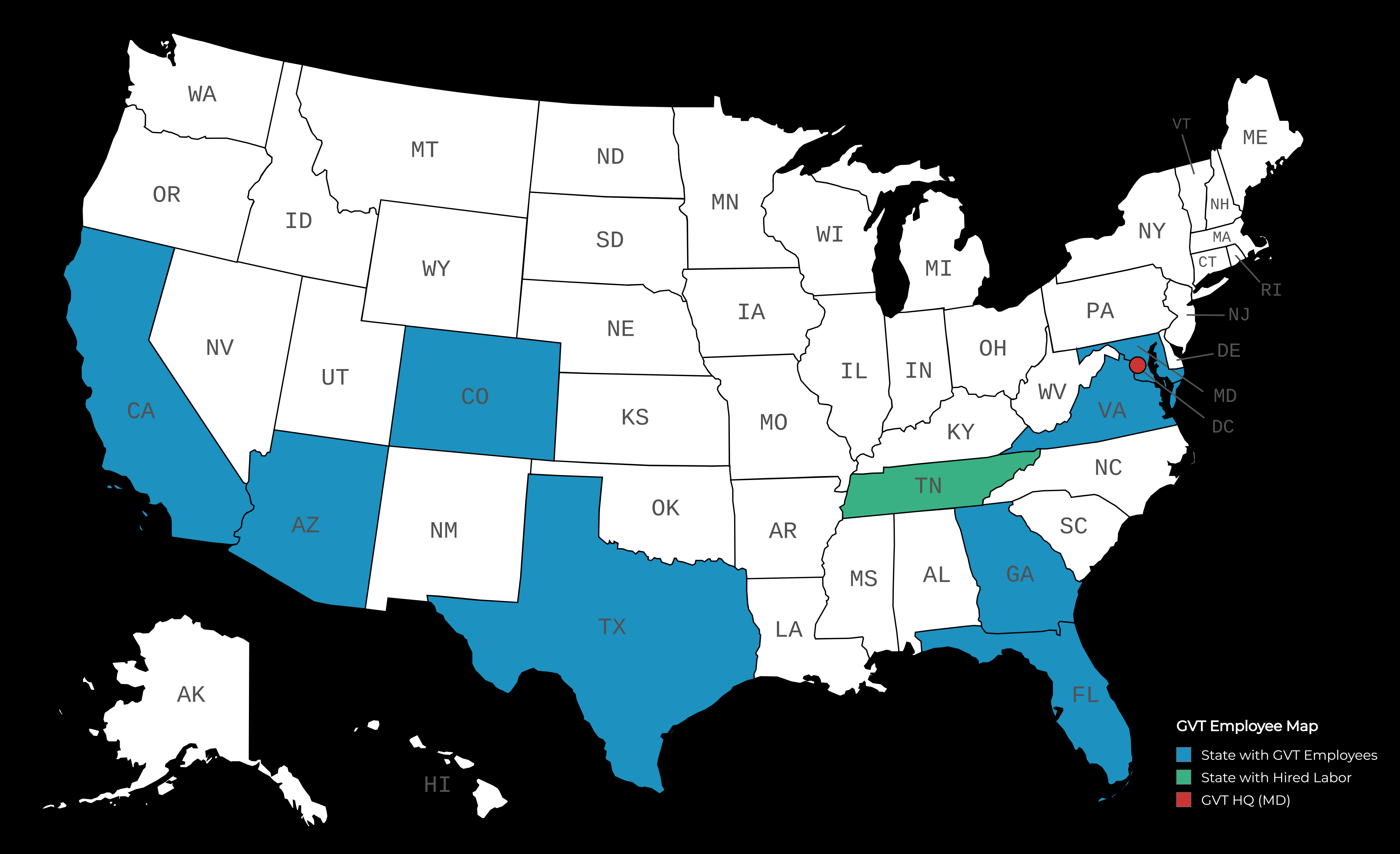
GVT. Engineering a better future.
We are a small business dedicated to solving Earth’s challenges through Space.


Introduction
/ Welcome To GVT
Top-notch engineering teams delivering solutions on schedule.
GVT strives to:
– provide unmatched customer support
– reduce overall costs through a streamlined approach
– provide thoughtful system design
– use proven technologies
– implement effective processes
About Us
/ Who We Are
GVT consists of elite engineers with extensive experience on critical aerospace missions supporting multiple government agencies.
Expertise
/ Subject Matter Experts
GVT provides world class experts in the following domains:
01.
Systems / Digital Engineering (MBSE) & Software Engineering

02.
Electrical & Mechanical Engineering
03.
Robotics & Aerospace Engineering
04.
Mission Operations & IT Security
05.
High-Performance Computing & Enterprise Cloud Solutions
06.
Artificial Intelligence & Large Language Model (LLM) Integration

Feature
/ Work We Have Performed
We’re here to solve any problems encountered on the mission.
Contracting
Supported 10+ first-tier Subcontracts and 50+ Task Orders at NASA Goddard Space Flight Center (GSFC)
Great Experience
Largest development subcontractor supporting NOAA LGSS with a focus on systems engineering and software engineering
Missions We Impact
/ Programs
Credit: NOAA NESDIS
Low Earth Orbit.
Joint Polar Orbiting Satellite System (JPSS) & Near Earth Orbit Network (NEON) Programs
At GVT, we proudly support the Low Earth Orbit (LEO) satellite missions led by NOAA, NASA, and international partners — programs that have delivered more than fifty years of continuous climate data and global insight. These satellites form the foundation of the world’s long-range weather forecasting systems, providing over 80% of the data used in 3- to 7-day predictive models. Our team contributes engineering expertise that helps ensure these vital systems perform with precision and reliability. Beyond forecasting, LEO satellites play a crucial role in monitoring wildfires, droughts, floods, air quality, coral reef health, and coastal waters — delivering the environmental intelligence that protects communities and supports global resilience.

Joint Polar Satellite System (JPSS) program — a cornerstone of global environmental monitoring. Operating in low Earth orbit, JPSS satellites deliver continuous data from missions including Suomi NPP, NOAA-20, and NOAA-21, with future satellites expanding that capability. Through advanced ground systems engineering, GVT helps enable the command, control, and data processing that keep these vital missions running. JPSS plays a critical role in forecasting weather, monitoring climate and oceans, and protecting lives, property, and the nation’s economy.
NEON program — a next-generation initiative redefining how environmental data is collected and applied. NEON enables advanced atmospheric, marine, terrestrial, and polar observations, providing critical data for weather prediction, fire and flood modeling, and climate research. By helping power the tools that make a Weather-Ready Nation, GVT plays a key role in transforming environmental intelligence into real-world resilience.
GVT supports critical missions that help protect life and property.
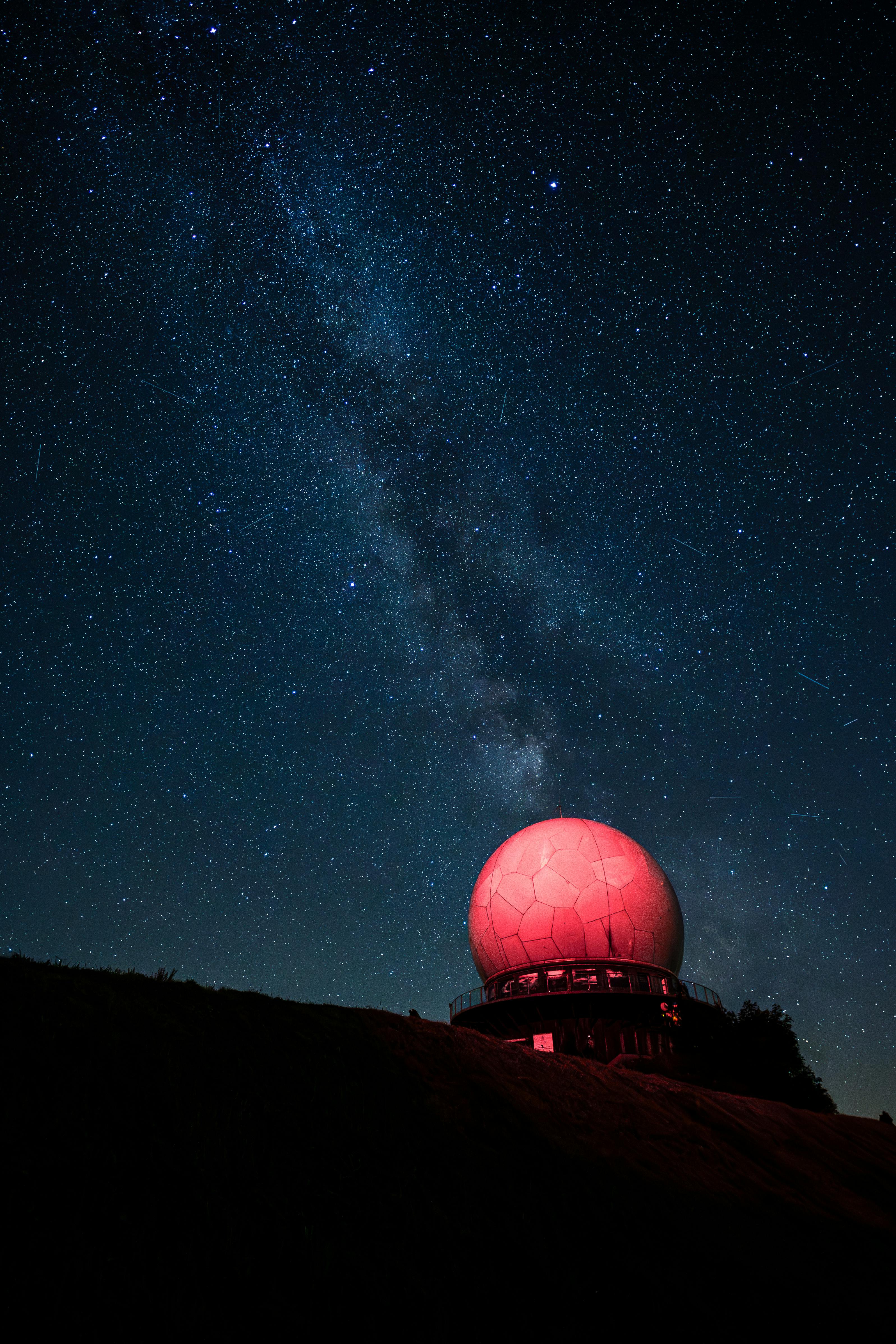
Outer Space.
Nancy Grace Roman Space Telescope
At GVT, we are honored to support NASA’s Roman Space Telescope, a next-generation observatory designed to unlock new discoveries in dark energy, exoplanets, and infrared astrophysics. Featuring a 2.4-meter primary mirror — the same size as Hubble’s — the Roman Telescope will deliver an extraordinary view of the cosmos. Equipped with the Wide Field Instrument and the Coronagraph technology demonstration, it will push the boundaries of space observation and expand our understanding of the universe.
Charms.
The Cryogenic, High-Accuracy Refraction Measuring System (CHARMS) is capable of accurately measuring the index of refraction of typical Infrared (IR) materials with a precision of (+ or -) 5 x 10sup -3. Preprint Document
View more projects

Location
/ Our whereabouts
Where is GVT?